
Beginner / Focused workshop
Value Massing in Drawing: Simplify a Still Life Into 3 Groups
Simplify a still life into light, middle, and dark value masses so the drawing reads clearly before blending, texture, or detail.
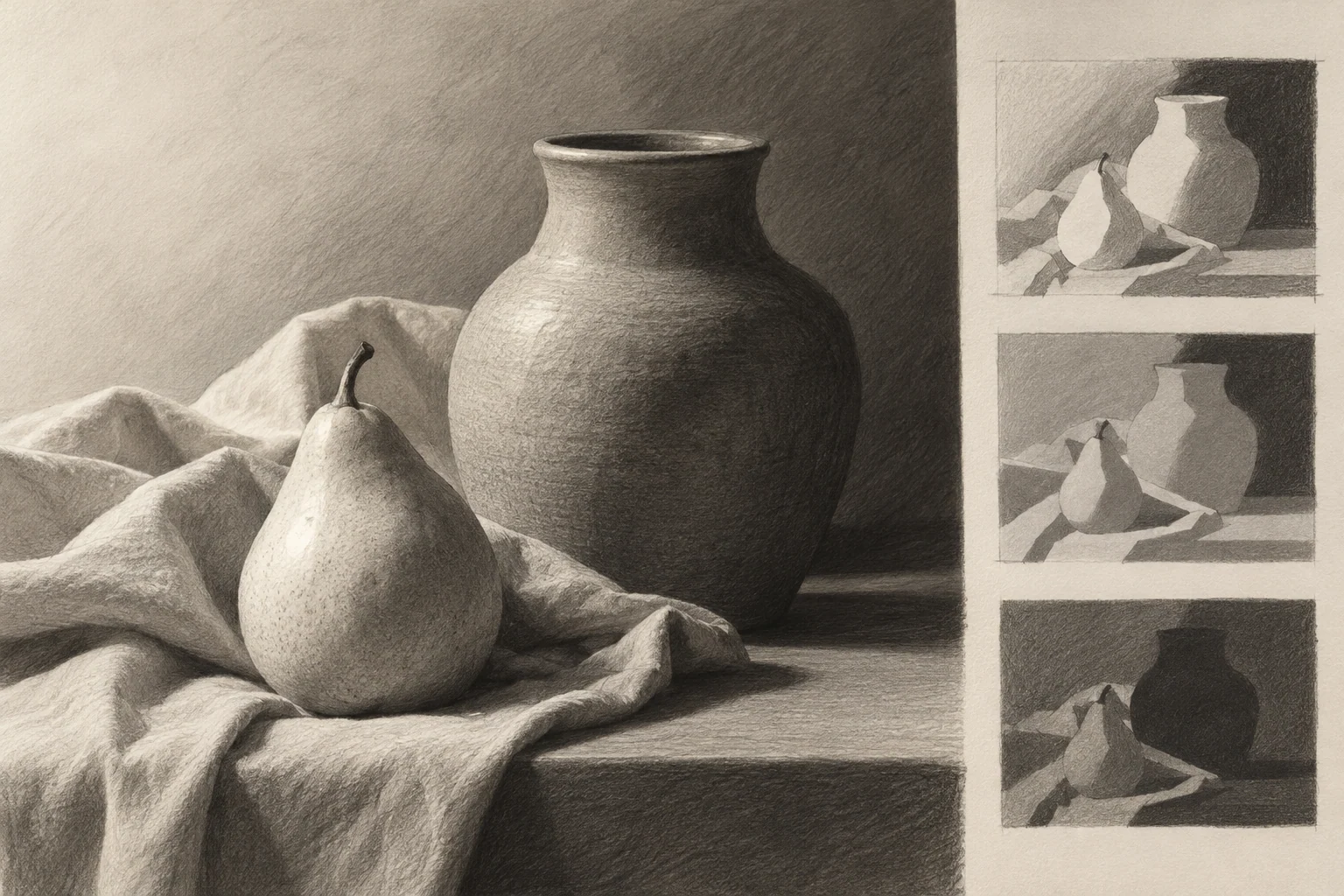
Set up one focused study.
Keep the first attempt small enough to repeat once. Compare decisions instead of judging talent.
- Level
- Beginner
- Practice time
- 35–50 minutes
- Skill focus
- Value grouping, shape design, hierarchy
- Success looks like
- Create a three-value thumbnail and a larger drawing that preserves the same readable value structure.
Materials
- Drawing paper
- HB and 2B pencils or charcoal
- Eraser
- Three simple objects
- One directional lamp
Create a three-value thumbnail and a larger drawing that preserves the same readable value structure.
Set one clear light source
Arrange three objects under one directional lamp. Turn off competing lights when practical so the value pattern is easier to read.
Choose objects with different heights or silhouettes, but avoid a setup so complex that the first exercise becomes a rendering marathon.
Squint to combine small changes
Squint or step back until small texture and colour differences become less distracting. Identify the broad light, middle, and dark families.
Two areas do not need identical values to belong to the same group. Grouping is a useful simplification, not a claim that the scene contains only three tones.
Design a three-value thumbnail
Fill a small rectangle using paper white, one middle graphite, and one dark. Connect adjacent dark shapes when they support a stronger design.
Check whether the objects remain distinguishable through silhouette, overlap, and value placement.
Transfer the masses before modelling
Enlarge the main shapes lightly. Place the largest dark and middle groups before blending transitions or drawing texture.
Keep the light family clean. An eraser can refine an edge, but it should not carry the entire job of preserving light.
Add only details that clarify form
Introduce selected halftones, reflected light, and accents after the large pattern reads. Avoid breaking every shadow into many unrelated patches.
Compare the final drawing with the thumbnail from a distance. If the value pattern changed accidentally, repair the grouping before adding more finish.
Diagnose the decision—not your talent.
Common mistakes
Every surface becomes a separate value
Group neighbouring areas before describing local colour or texture.
The darkest value appears everywhere
Reserve it for selected accents and connected shadow masses.
Blending begins before the structure works
Establish the three groups first, then soften only necessary transitions.
Self-check
- The light direction is clear.
- Three broad value families remain visible.
- The thumbnail and larger drawing agree.
- Details support rather than fragment the value pattern.
Technical references
LUREXEN independently synthesised this lesson from observation practice and the following education pages. Links are provided for verification; they are not sponsorships.