
Beginner / Focused workshop
Composition Thumbnails for Beginners: Plan Before You Draw
Use small composition thumbnails to test cropping, focal placement, negative space, and value masses before beginning a larger drawing.
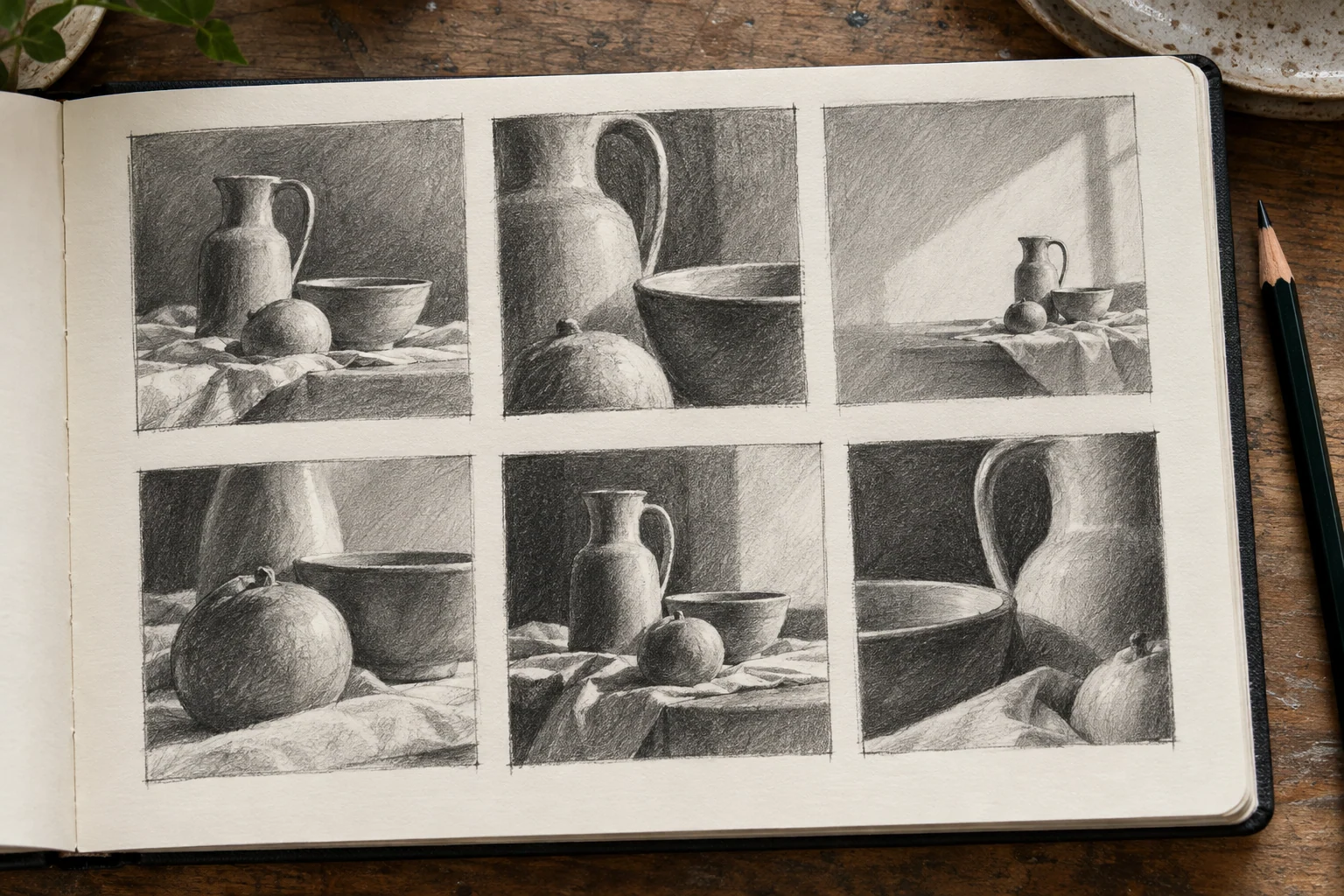
Set up one focused study.
Keep the first attempt small enough to repeat once. Compare decisions instead of judging talent.
- Level
- Beginner
- Practice time
- 25–35 minutes
- Skill focus
- Cropping, hierarchy, value masses
- Success looks like
- Produce six distinct thumbnails and select one because its arrangement supports a clear focal idea.
Materials
- Sketchbook or copier paper
- Soft graphite pencil
- Black marker or charcoal (optional)
- A simple still life or your own reference
- Two paper L-shapes for a viewfinder (optional)
Produce six distinct thumbnails and select one because its arrangement supports a clear focal idea.
Work small enough to decide quickly
Draw six rectangles only a few centimetres wide. At this scale, you cannot hide a weak arrangement behind texture or detail.
Keep the subject constant. Change the framing and placement so each thumbnail tests a real alternative.
Change the crop
Try one wide frame, one taller frame, one close crop, and one with more surrounding space. Notice how the same objects feel quieter, more crowded, or more directional.
Do not centre every object automatically. Let the crop create useful tension without accidentally cutting a form at an awkward point.
Group the values
Reduce the scene to three broad groups: light, middle, and dark. Fill them simply without modelling every surface.
If the thumbnail becomes a patchwork of small unrelated values, combine neighbouring shapes.
Control the focal hierarchy
Place the strongest contrast, sharpest edge, or most distinctive shape where you want attention to gather. Other areas can support that decision through quieter values and simpler contours.
Hierarchy does not require a dramatic subject; it requires unequal emphasis.
Choose with a written reason
Circle one thumbnail and write why it works: the crop, the value pattern, the movement, or the negative space. Enlarge its large shapes before adding detail.
Keep a second option. If the larger drawing stalls, compare it with the thumbnail rather than improvising every change.
Diagnose the decision—not your talent.
Common mistakes
Six thumbnails are nearly identical
Change one major variable in every frame.
Tiny details replace value masses
Use a broad pencil side or marker to force simplification.
Choosing the neatest drawing instead of the strongest plan
Judge arrangement and hierarchy, not polish.
Self-check
- All six thumbnails differ meaningfully.
- Each has readable light-middle-dark groups.
- One area has intentional emphasis.
- My selected thumbnail has a written reason.
Technical references
LUREXEN independently synthesised this lesson from observation practice and the following education pages. Links are provided for verification; they are not sponsorships.