
Beginner / Focused workshop
Limited Watercolor Palette: Learn More With 3 Colors
Build a practical three-color watercolor palette by testing parent colors, mixtures, neutrals, dilution, and one small study.
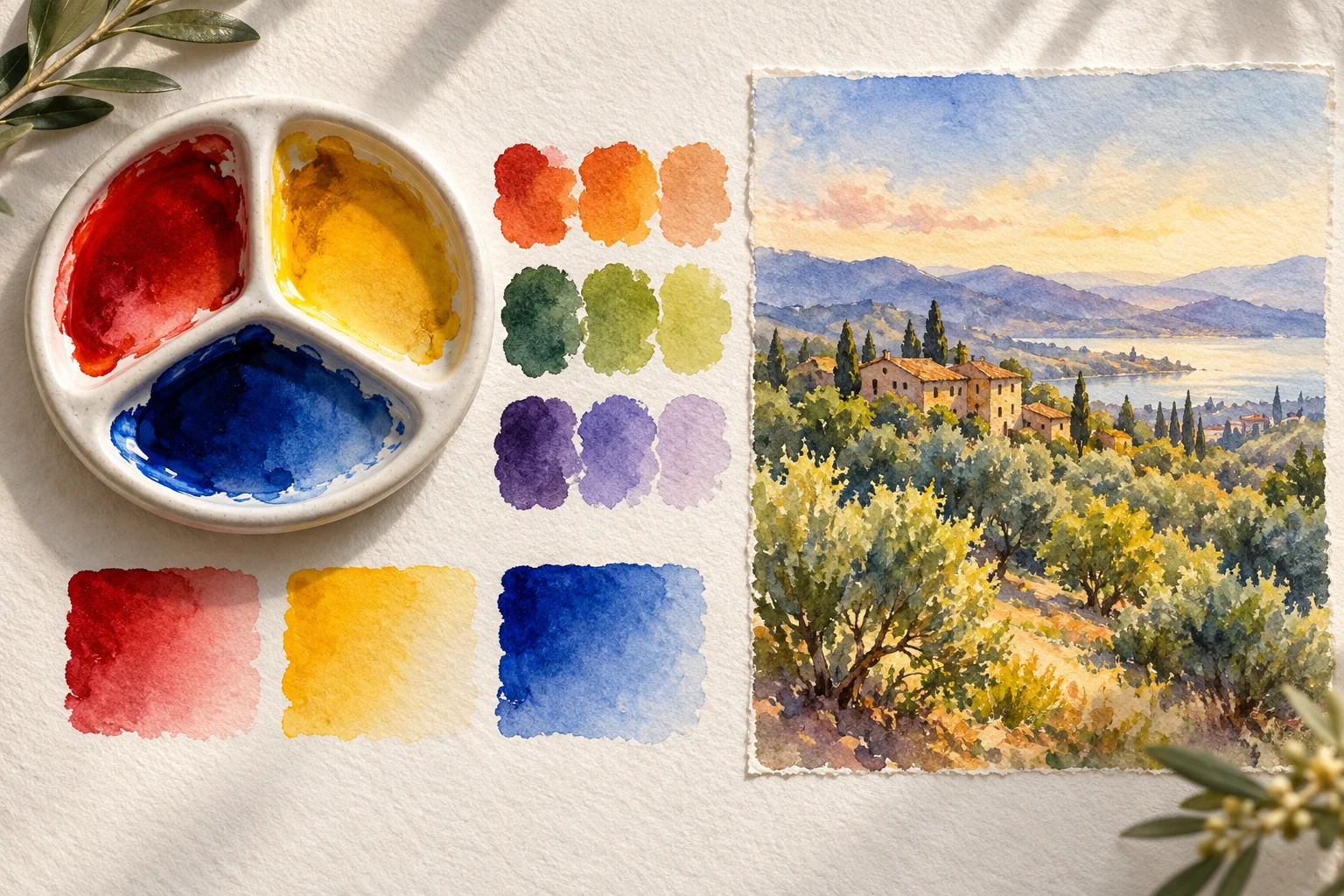
Set up one focused study.
Keep the first attempt small enough to repeat once. Compare decisions instead of judging talent.
- Level
- Beginner
- Practice time
- 40–55 minutes
- Skill focus
- Colour relationships, mixing, value
- Success looks like
- Create a labelled palette map and a small study using only three chosen paints and paper white.
Materials
- Watercolor paper
- One yellow, one red, and one blue
- White palette
- Round brush
- Water, cloth, and pencil
Create a labelled palette map and a small study using only three chosen paints and paper white.
Start with known pigments
Write the paint names or pigment codes beside three parent swatches. A limited palette is useful only when you know what produced the mixtures.
Choose paints you already own before buying a special set. The exercise is about relationships and repeatability.
Map the secondary mixtures
Mix yellow with red, red with blue, and blue with yellow. Place several ratios between each pair rather than aiming for one perfect orange, violet, or green.
Keep the brush and mixing wells clean enough that an accidental third pigment does not enter every test.
Find useful neutrals
Bring all three colors together in small controlled ratios. Look for a neutral that can lean warm or cool instead of chasing a generic black.
Compare changing pigment ratio with adding water. Ratio changes hue and intensity; water primarily changes concentration and value.
Plan a small value structure
Choose one light, one middle, and one dark mixture for a postcard-sized subject. Reserve paper white rather than adding opaque white by habit.
The palette is limited, but the value range should not be. Mix a sufficient dark before the painting begins.
Record what the palette can and cannot do
Paint one simple landscape or still life. Note the mixtures that were easy, the ones that became dull, and any colour you genuinely missed.
Use that evidence to adjust one parent colour next time instead of expanding immediately to many paints.
Diagnose the decision—not your talent.
Common mistakes
The palette map has no labels
Record paint names while the mixtures are still in front of you.
Every mixture contains all three colors
Keep pair mixtures separate before exploring neutrals.
A limited palette becomes a limited value range
Prepare a deliberate dark and preserve clear lights.
Self-check
- All three parent colors are identified.
- Pair mixtures show more than one ratio.
- I separated dilution from pigment ratio.
- The small study has a readable light-middle-dark pattern.
Technical references
LUREXEN independently synthesised this lesson from observation practice and the following education pages. Links are provided for verification; they are not sponsorships.