
Drawing / Beginner
Draw a Gingerbread Cookie by Leaving the Icing White
Practise a festive biscuit silhouette, a thin baked edge and a short cast shadow while saving the icing as blank paper.
Choose one cookie shape
Use a real cookie or a photograph you can legally study. A simple gingerbread person works well, but a star or tree is also suitable. Place the cookie on plain paper under one steady light. An HB pencil, a softer pencil if available and an eraser are enough.
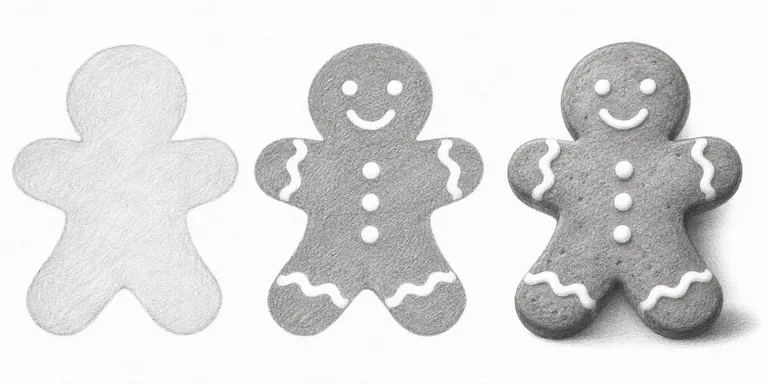
Begin with the overall height and width. Sketch the head, arms and legs with light rounded shapes, joining them into a single silhouette. Slight irregularities can suggest a baked object; perfect symmetry is unnecessary.
Map the icing as empty shapes
Before shading, draw the visible icing bands lightly. Keep them wide enough to remain white on the page. Mark the face and buttons as simple shapes with room around them. In this exercise the icing is reserved paper, not a dark outline filled in later.
Check the space between the cuffs and the cookie edge. If those gaps are too narrow, simplify the decoration now. A readable large icing shape is more useful than many cramped marks.
Lay in the biscuit tone
Use the side of the pencil to build an even light midtone across the biscuit, carefully working around the icing. Add tone with several gentle passes rather than pressing hard immediately. On a spare swatch, compare closely spaced marks with wider ones before choosing your texture.
Describe thickness and contact
Observe which part of the cookie edge is visible. Add a narrow darker strip on that side, making it follow the silhouette. Keep the strip narrow enough that the biscuit still looks thin. Place a cast shadow on the paper opposite the light, darkest where the cookie touches the surface.
Add only a few tiny texture marks. Do not cover all the biscuit with equally dark dots, and keep the white icing clean. Lift stray graphite gently with the eraser if the paper allows it.
Review the festive study
The cookie should read from its silhouette, biscuit tone and reserved icing before any tiny detail. If it looks flat, check the edge and contact shadow first. Try a second cookie with one fewer icing band. Compare whether the simpler decoration reads better at the size of a gift label.