
Watercolor / Beginner
New Year Watercolor Fireworks: Paint the Gaps Around the Light
Make a small New Year card by reserving broad paper-white rays, then painting a dark sky between them instead of adding hundreds of tiny sparks.
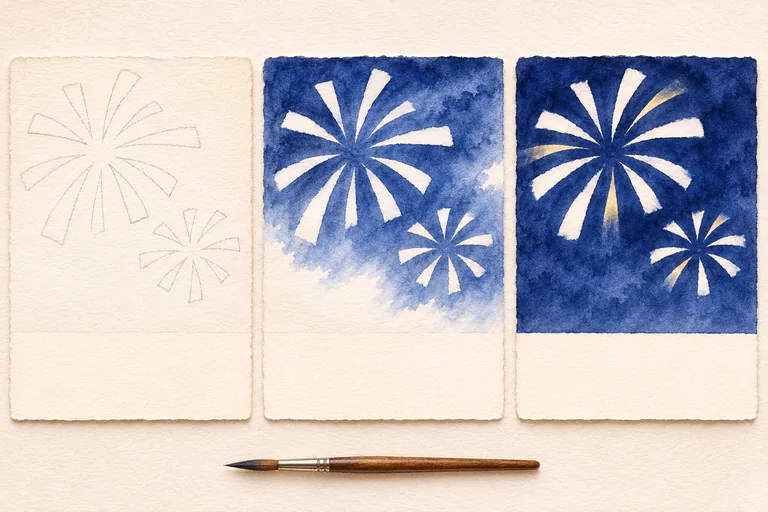
Design a card with room to breathe
A New Year card does not need a crowded skyline to feel celebratory. Try two firework bursts of different sizes with an open strip below for a greeting. This is a painting exercise for New Year’s Eve and the start of 2027, using an imagined display or a photograph you have permission to study. It does not involve handling fireworks.
Use watercolor paper, a round brush with a reliable point and a blue paint that can make both a pale wash and a darker mixture. A little violet can shift the sky color if you already have it. Test the mixture first. You do not need metallic paint or masking fluid for this broad-ray version.
Reserve fewer, wider rays
Lightly mark one main center above the middle of the picture and a smaller center to one side. Around each, sketch a modest number of tapered rays. Leave clear gaps between them. Keep the rays broad enough to paint around without needing a hairline brush stroke; about eight to twelve main rays is a workable starting choice, not a rule for real displays.
Vary their lengths and interrupt a few near the outer edge. Avoid placing every ray on an identical circular rim. Keep the two bursts separate enough that their reserved shapes will not merge into one white knot.
Paint the sky between the shapes
Work on dry paper for a more controlled boundary. Paint one manageable gap between two rays with diluted blue, then continue around the burst, leaving the ray shapes as untouched paper. Join neighboring wet sky areas while you can still move the paint comfortably. Do not repeatedly scrub a drying edge in an attempt to make every section identical.
For the first study, a slightly uneven sky is preferable to losing the whole light pattern. If narrow spaces become frustrating, enlarge the design or reduce the number of rays. Practice should make the brush task manageable.
Deepen selected sky areas after drying
Allow the first layer to dry fully. Add a second transparent dark layer to selected parts of the sky, again preserving the rays. Leave a little variation around the bursts so they are not pasted onto a uniformly black rectangle. Test the dried swatch before darkening the actual card.
Keep a tiny unpainted center only if it remains distinct from the rays. A pale yellow glaze on a few dry rays is optional; leave others as paper. You are suggesting light through contrast, not reproducing the physical brightness of a firework.
Finish with restraint
When the painting is dry, decide whether it needs just three or four small detached spark marks. Skip them if the main bursts already read clearly. Add your greeting in the reserved strip only after testing the pen on scrap paper. A test mark is easier to replace than a blurred word across the finished sky.
If you accidentally paint over a ray, do not promise yourself that lifting will restore the original white: pigments differ in how strongly they stain. Treat that ray as a shorter one or keep the sheet as a study. For more practice around pale shapes, compare the frost-window lesson, or browse the watercolor collection.