
Watercolor / Beginner
Paint a Glass Christmas Bauble in Watercolor: Preserve the Highlights
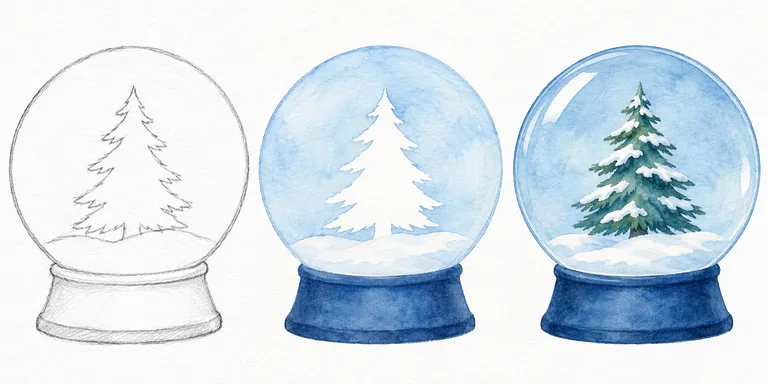
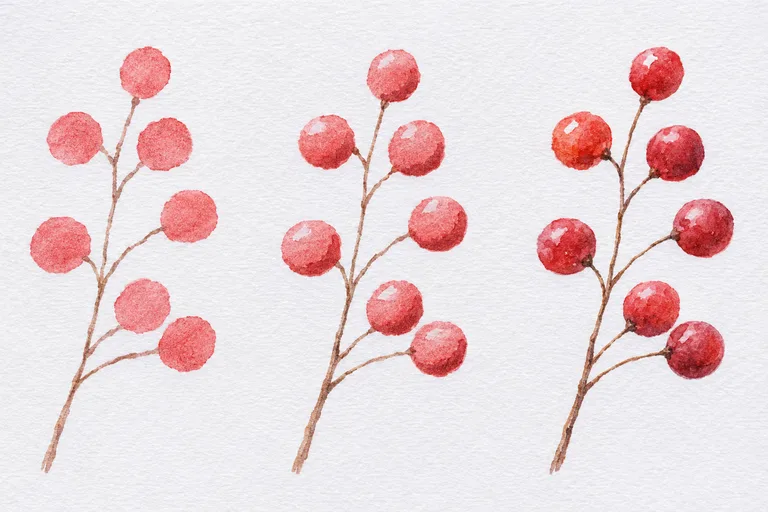
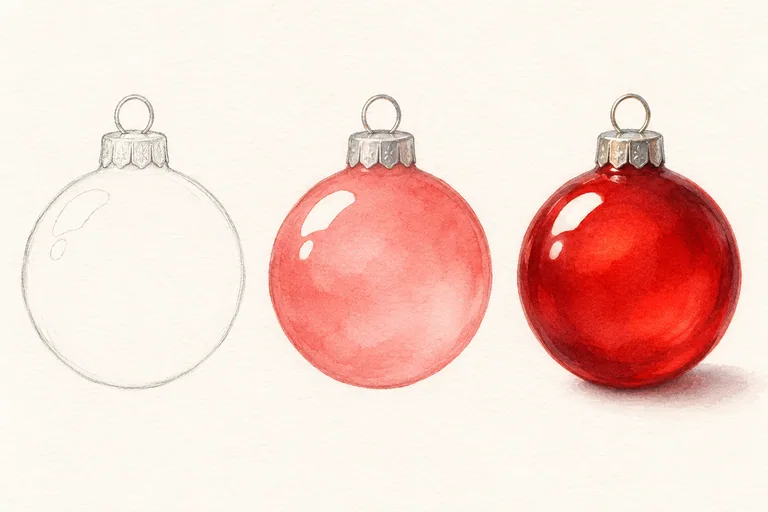
Suggest a red glass ornament with a light first wash, curved value changes and highlights reserved from the beginning.
Choose a readable ornament reference
One plain glass bauble is enough for this study. Use your own photograph or observe an ornament on a secure surface. Choose an angle with a clear highlight and a simple background. A crowded reflection contains more information than this beginner exercise needs.
The goal is a glass-like suggestion, not an exact optical reconstruction. Use watercolor paper, a pencil, a pointed round brush and red paint. Test a little blue or violet with the red if you need a darker mixture. Keep the test separate from the painting until you know how it dries.
Place the sphere, cap and saved light
Sketch the round silhouette lightly. Attach one small cap at the top and connect its hanging loop to it. Check that the cap sits on the ornament instead of floating beside it. Mark the main highlight on the side facing your reference light, plus a smaller reflected light only if you can see one.
Keep those shapes as untouched paper. A highlight is part of the plan, not something you must recover by rubbing later. Remove heavy pencil marks before painting because they may remain visible through transparent washes. Leave enough room around the hanging loop for a clean edge.
Begin lighter than the finished red
Lay a pale red wash around the reserved highlights. Keep the outline round without tracing it with a heavy dark ring. A slightly stronger wash along the side away from the light can begin the sense of volume. Avoid flooding the paper so heavily that water runs into the saved white areas.
If a bead of paint gathers at the bottom, lift excess moisture with a clean, blotted brush. Do not keep brushing the whole surface as it begins to dry. Let this layer dry completely before deciding where more color is needed.
Make darker shapes curve with the sphere
Add a controlled second layer on selected lower and side areas. Let its boundary curve around the sphere. Keep a broad middle-red area between the darkest accents and the highlights; without it, the ornament can look like a white circle beside a black stripe.
Follow your reference rather than darkening every edge equally. Where a transition should soften, use a clean damp brush with less water than the painted area. Keep other boundaries clear. For this exercise, a few convincing value changes explain more than a maze of invented reflections.
Finish the metal and contact shadow
Paint the cap with a pale neutral gray, preserving a narrow light edge. Add one darker crease or lower edge after it dries. The loop should remain a single connected structure. Do not turn overlapping pencil lines into several extra loops.
If the ornament rests on a surface, place a small contact shadow immediately beneath the contact point and let it soften outward. If you choose a hanging reference instead, omit that ground shadow. A hanging ornament and a tabletop shadow would tell conflicting stories.
Check the glass effect before adding detail
View the painting from a distance. Are the main white highlight and the darker curved areas still distinct? If the bauble looks flat, check the distribution of light, middle and dark values before increasing saturation. If the highlight was lost, make a fresh small study; adding opaque white would change the transparent-watercolor method used here.
Let the painting dry before adding a greeting or cutting it into a card front. Colors and edges will depend on paper, pigment and water control. The example image illustrates the plan; it is not a recorded demonstration or a promise of an identical result.