
Drawing / Beginner
Color a Candy Cane with Pencils: Make the Stripes Turn Around the Hook
Keep a festive striped drawing dimensional with curved boundaries, a reserved highlight and a light touch on the white bands.
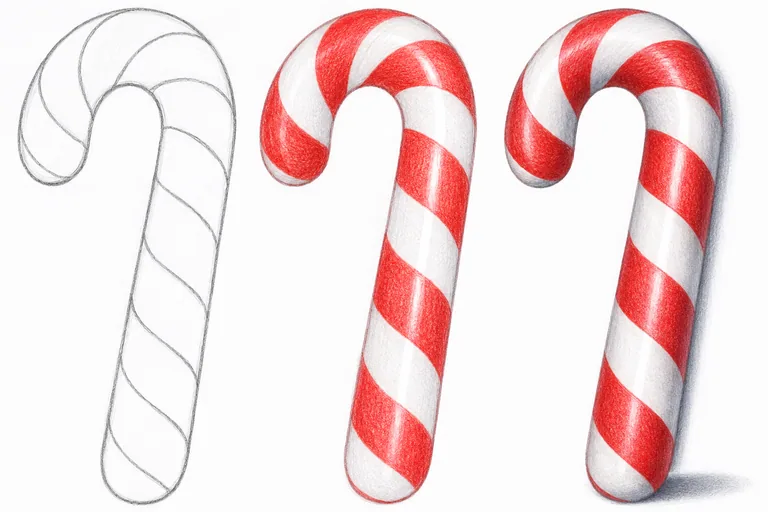
Build one continuous hook
A candy cane makes a compact holiday coloring exercise: the challenge is keeping the pattern connected to a curved form. Use drawing paper, a graphite pencil, red colored pencil and a cool gray or pale blue pencil. You can work from a real candy cane without opening it, or from a suitable reference image.
Draw a long line that curves over at the top. Add a second outline on each side to give the cane a fairly even thickness. Look carefully at the inside of the hook: its curve is tighter than the outside. Avoid making the opening so small that the two sides merge.
Wrap the stripe boundaries
Mark a few diagonal bands on the straight stem. Curve their boundaries slightly to suggest the round surface. Continue them around the hook in shorter sections, checking the reference instead of copying the stem angle unchanged. Make each band reach both visible edges of the cane.
Before coloring, follow one white gap from edge to edge. If a red band ends halfway across the form or changes width abruptly, correct the light drawing now. You do not need a mathematically exact spiral, but the pattern should look continuous.
Build the red gently
Lay a pale red layer inside the alternating bands. Use light pressure, then add another layer where you need more strength. Leave a narrow lighter area along the lit face of each red band. The highlight may bend as it reaches the hook, following the surface rather than staying as a ruler-straight stripe.
Use a sharper point near the boundaries and a shallower pencil angle for broader areas. Avoid pressing hard immediately; heavy early pressure can reduce the paper’s ability to take more layers.
Shade the white without making it dirty
Keep most of each white band as untouched paper. Add a very pale cool shadow along the edge facing away from the light, and deepen a few areas near the inside curve of the hook if your reference shows them. The white bands should remain clearly lighter than the red ones.
If you add a cast shadow, place it consistently with your chosen light direction. Keep it small and quiet so it supports the cane instead of competing with the pattern.
Check the hook before the details
- Does the whole object keep roughly the same thickness?
- Do the bands travel across both the straight stem and the hook?
- Can you still see clean white paper in the light bands?
Try this on scrap paper before coloring a detailed festive scene. For broader palette decisions, see the three-color planning lesson. Use a protective spare sheet beneath a coloring page if your materials may transfer, and test markers separately; this exercise is written for pencils.