
Drawing / Beginner
Make a December Drawing Countdown: 24 Small Prompts, Four Useful Skills
Turn a December sketchbook page into a manageable drawing countdown, moving from outlines to overlaps, values and a final small scene.
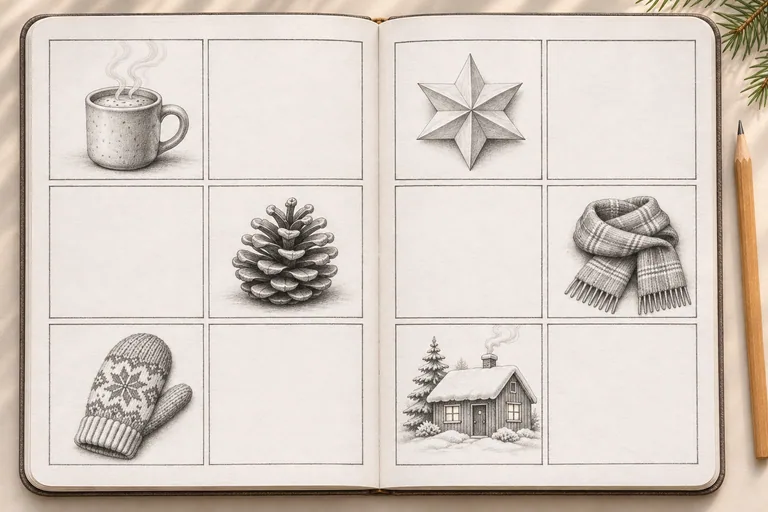
Choose your own December rhythm
A drawing countdown works best when its daily task is small enough to finish. This plan runs from December 1 to 24 and uses ordinary objects rather than a new elaborate scene every day. It is a creative countdown; it does not reproduce the liturgical Advent calendar. In 2026, the first Sunday of Advent is November 29.
Use an HB pencil, an eraser and a sketchbook. Divide a spread into 24 spaces only if each space remains comfortable to draw in. Two spreads with 12 larger spaces can be easier to use than 24 cramped boxes. Alternatively, use a separate small page each day. No downloadable calendar or PDF is included with this article.
Days 1–6: make a readable outline
- A cup seen from the side: compare its height and width.
- A mitten: connect the thumb clearly to the body.
- A folded paper star: settle the outer points first.
- A plain candle shape: compare the top ellipse with the sides; an unlit candle is enough.
- A pine sprig: vary the length of the needle groups.
- A biscuit cutter: draw its empty center before its thickness.
Work from objects you have or photographs you may use. Spend most of the session looking at the outside shape. Do not add shading simply to fill the box.
Days 7–12: decide what sits in front
- Two stacked books with unequal widths.
- A scarf folded over a chair back.
- A ribbon crossing a gift box.
- A spoon resting on a folded napkin.
- Two envelopes, one partly covering the other.
- A bauble partly hidden behind a pine twig.
At each crossing, stop the edge belonging to the object behind. If the overlap is unclear, correct the drawing before adding texture. Compare the stacked-envelope exercise when two edges seem to compete.
Days 13–18: use three value groups
- A white mug with one light side and one shadow side.
- A pear resting on the table.
- A walnut with only a few shell ridges.
- A folded cloth with one broad dark fold.
- A plain cardboard box under one lamp.
- A pine cone with grouped shadow gaps.
Keep paper for the lightest group, a quiet middle tone and a smaller dark group. You do not need to polish every drawing. Note one useful observation beside it, if you want, rather than giving yourself a score.
Days 19–24: combine a little, then stop
- A cup beside one closed book.
- A window corner with a potted plant.
- A small gingerbread-house front.
- A folded scarf beside a mitten.
- A gift and a single loose ribbon.
- Your own quiet December scene with only three objects.
If you miss a day, continue with the next prompt or extend the countdown. Avoid turning a missed box into six rushed catch-up drawings. On the last day, compare your first outline with one later study and identify one concrete improvement, such as a clearer overlap or a more balanced ellipse. The useful result is a record of practice, not a perfectly filled grid.