
Drawing / Beginner
Draw a Christmas Bell with Light and Dark Reflection Bands
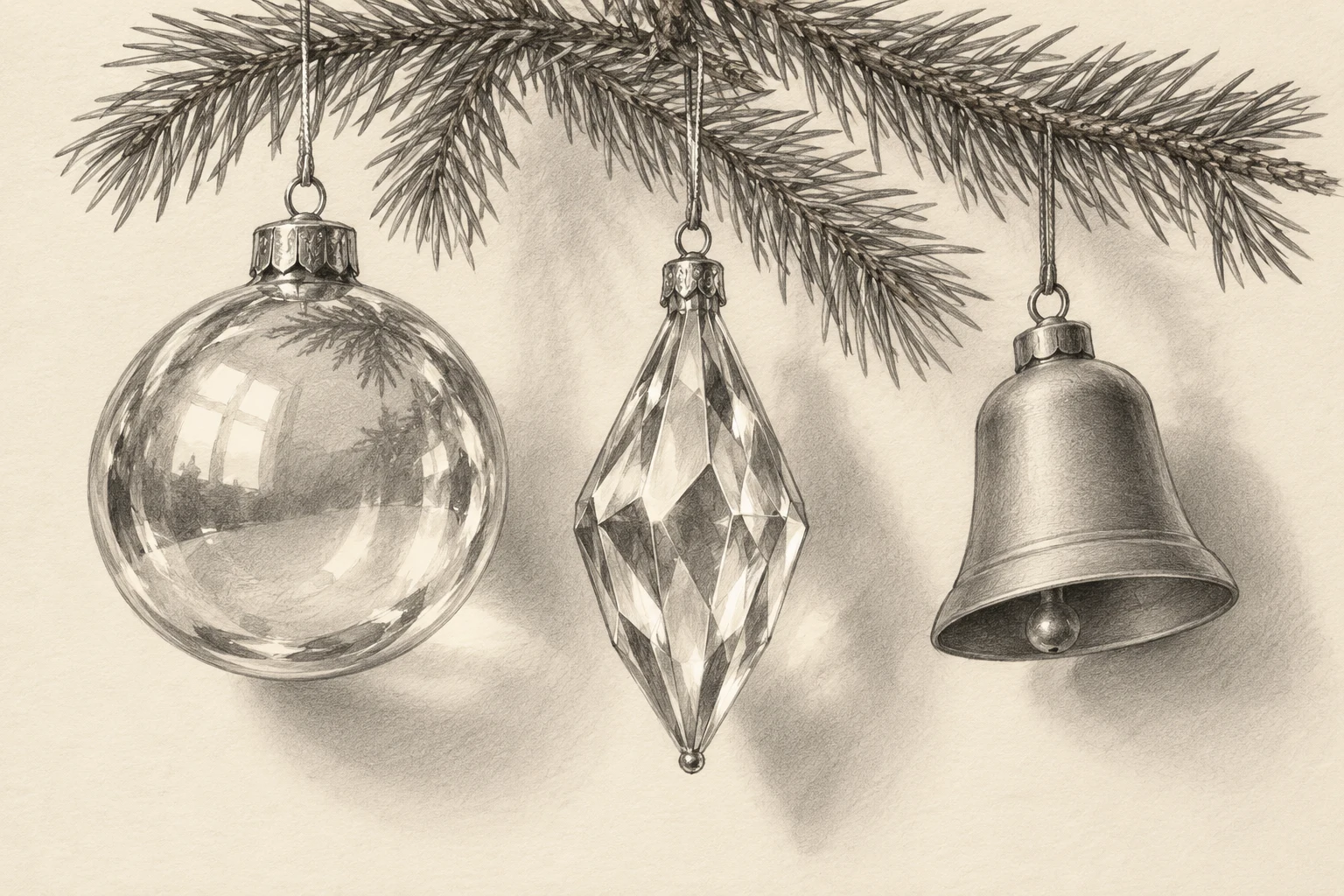
Give a small bell a metallic appearance using a few observed value bands and a clear elliptical opening.
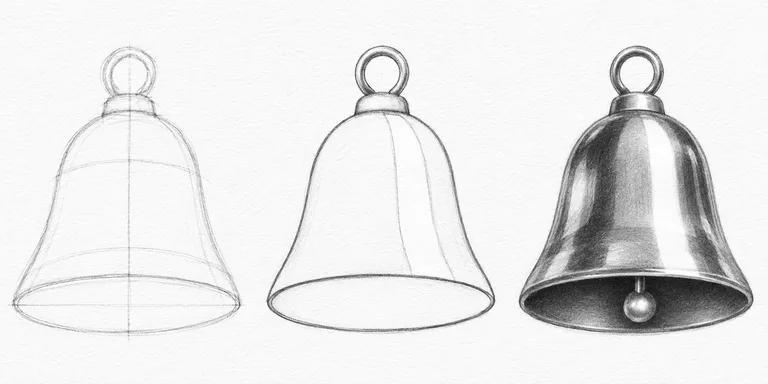
Set up one clear reference
Choose a small bell or a photograph with readable reflections. Metal reflects its surroundings, so moving the object or changing the viewpoint can change its light and dark shapes. Keep both fixed for this study. Use drawing paper, HB and a softer pencil, plus an eraser.
Start with a vertical center line. Mark the top, widest point and bottom, then sketch the outer dome around that framework. Add the top loop only after the main bell shape looks balanced.
Check the opening
Draw the bottom opening as an ellipse that matches the viewpoint. Its near and far edges should belong to the same plane. If you can see a clapper, locate it inside the opening. Do not place it randomly below the rim simply because you remember bells that way.
Compare the width of the opening with the height of the body. Correct these relationships before adding dark graphite. Strong shading cannot repair a rim that points in an incompatible direction.
Group the reflections into bands
Squint at the reference and identify a bright band, a middle-value area and a dark reflection. Sketch those boundaries very lightly. Keep the bright band as paper for now. Avoid assuming every metal object has the same stripe pattern; the arrangement comes from your chosen reference.
Build contrast selectively
Lay a light graphite tone over the middle-value area. Add the darker band in layers, keeping its edge relatively clear where the reflection changes abruptly. Soften only the boundaries that are genuinely gradual. A mixture of crisp and softer transitions can suggest polished metal.
Darken the visible interior of the opening, leaving the rim lighter where it catches light. Give the clapper enough contrast to separate it, and add a modest cast shadow if the bell sits on a surface. Keep the outside contour lighter on the brightest side.
Stop before overblending
Check whether the white highlight is still clear and whether the dark reflection has a purposeful shape. Blending every boundary into the same gray can remove the metallic contrast. For a second study, draw only the three largest reflection shapes. Use the result as a small seasonal sketch or the starting point for a hand-drawn card.