
Drawing / Beginner
Draw a Cozy Coffee Sketchbook Page: Mug, Book and Spoon
Arrange three everyday objects into one readable pencil study, using shared spacing and selective shadows instead of filling the page with detail.
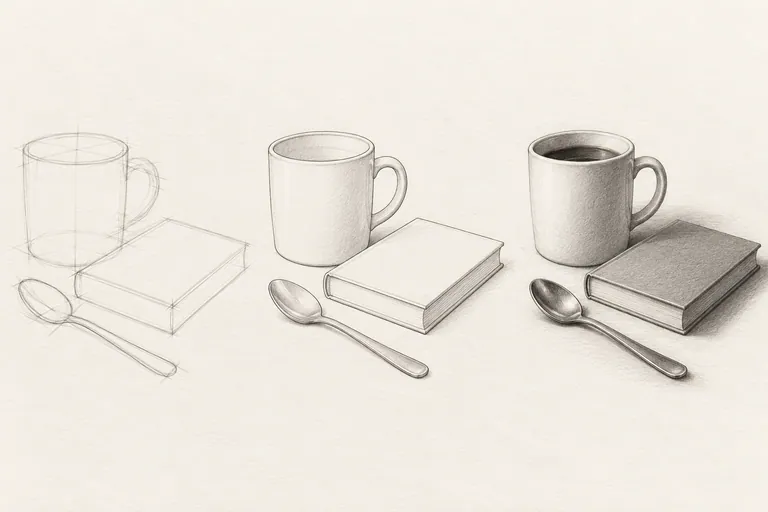
Build a small still life at home
A familiar coffee corner can become a drawing subject without buying special props. Choose a plain mug, a closed book and a teaspoon. Use an empty or cool mug while arranging the scene so you can move things comfortably. Place the objects on a clear surface with light coming mostly from one side.
Pinterest's 2026 hobbies report highlights home café setups and personal journaling. This lesson connects those interests through a small observational drawing. Its focus is the relationship between three objects, rather than another isolated cup study or a page of decorative lettering.
Find the group before its details
On drawing paper, lightly mark the outside limits of the whole arrangement. Keep the group smaller than the page so it has room to breathe. Place the mug toward one side, the book beside it and the spoon diagonally in front. You can change that layout to suit what you actually see.
Look at the empty spaces between the objects. Is the handle separated from the book? Does the spoon touch the mug outline in a confusing way? Shift the real objects until their shapes are easy to distinguish. Solving an awkward overlap now is easier than repairing it after shading.
Draw three clear silhouettes
- Block in the mug. Compare its height and width. Indicate the rim with a light ellipse and check the handle opening.
- Place the book as a shallow block. Observe which corners you can see. Keep the visible page edge simpler than the cover.
- Add the spoon. Mark its length and direction first, then its bowl and handle. Avoid making its width uniform from end to end.
- Compare the group. Check the gaps and relative sizes before darkening any outline.
The National Gallery of Art's everyday-object lesson introduces contour drawing and hatching. Here, contour helps keep the objects readable while a few shaded areas establish their relationship.
Give the shadows one light source
Observe the actual shadows on your table. With light coming from the upper left of the illustration, the main shadows extend toward the lower right. Your own setup may differ. Keep that direction coherent instead of placing an identical oval beneath each object.
Use light hatching for a broad shadow, then strengthen a few close contacts where the mug, book or spoon meets the surface. Leave much of the mug lighter. Add only enough cover tone to separate the book from its page edge; individual page lines can wait.
Leave some paper unworked
A cozy page can still be clear and restrained. Do not add steam, a logo, a quotation and a patterned tablecloth simply because there is unused paper. An open area can keep attention on the objects. If you want a note, write one short observation after the drawing is finished.
Step back and ask whether the three objects read immediately. If the handle merges with the book, adjust the arrangement next time. If the drawing feels heavy, keep fewer edges dark in the next study. For a useful comparison, move just the spoon and draw the group again at half size.
Continue with the cup proportion lesson if the rim needs attention. The goal here is a readable group you observed yourself, not a perfect replica of the illustrative example.