
Drawing / Beginner
Draw an Envelope in Pencil: Four Corners, a Flap and One Narrow Shadow
Use a familiar paper object to practise perspective, overlapping edges and restrained hatching without filling the whole drawing.
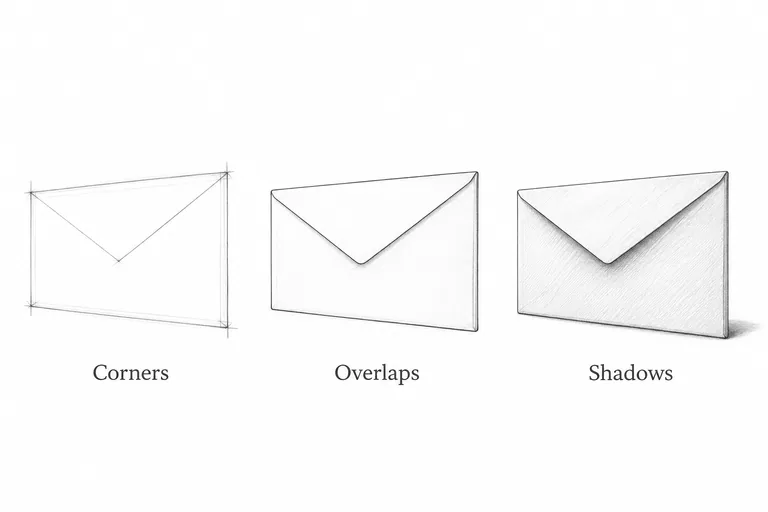
Use a real envelope as your reference
Place a closed envelope with its flap toward you. Turn it slightly and use one lamp or window as the main light. You need a pencil, eraser and ordinary drawing paper. This is an observation exercise, not a template for cutting or folding an envelope.
Mark the four outer corners lightly. Compare the height of the near edge with the far edge instead of forcing a perfectly flat rectangle. Join the points with tentative lines and check the overall width before adding the flap. Do not press hard while the proportions are still changing.
Make the flap overlap the body
Locate where the flap joins the upper edge and where its tip rests. Draw its two sloping edges as one clear shape. Erase construction lines that would incorrectly show through the paper. The flap should read as a layer resting on the envelope, not as a triangle drawn decoratively across a flat surface.
Use two different shadows
Add a narrow dark accent just beneath the flap where it touches the envelope. Keep that accent thin. Use lighter, more widely spaced hatching for the broader plane. Then draw the small cast shadow where the envelope meets the table, following the light you actually see.
Avoid making every outline equally dark. Strengthen only a few contact points and let the lit upper edges remain lighter. If the paper starts looking metallic, reduce the contrast and remove unnecessary dark lines.
A two-minute self-check
Cover the shading with a scrap: does the outline still make sense? Then uncover it and ask whether the flap appears to sit above the body. If not, correct the overlap before adding more graphite. Repeat from a different angle to practise seeing, rather than memorising a symbol.
This small still life connects to the letter-writing interest highlighted in Pinterest's 2026 report. The trend is creative context; the exercise is about perspective and edge hierarchy, not about copying a fashionable stationery design.