
Drawing / Beginner
Draw a Gingerbread House: Build the Walls Before the Icing
Construct a simple front-view gingerbread house, then use a few clear shadows to separate icing from biscuit without covering everything in texture.
Keep the first house facing you
A gingerbread house is an inviting Christmas drawing subject because it combines simple building shapes with playful decoration. The difficulty is that the decoration can hide a roof or wall that never fitted together. Begin with a front view. A straight-on rectangle and triangle let you practise structure without also solving a complicated angled building.
Use drawing paper, an HB pencil, an eraser and, if useful, a slightly softer pencil for the darkest accents. Refer to a real model, your own photograph or a reference you are allowed to use. You are drawing the house; this article does not provide baking or structural assembly instructions.
Fit the rectangle and the gable
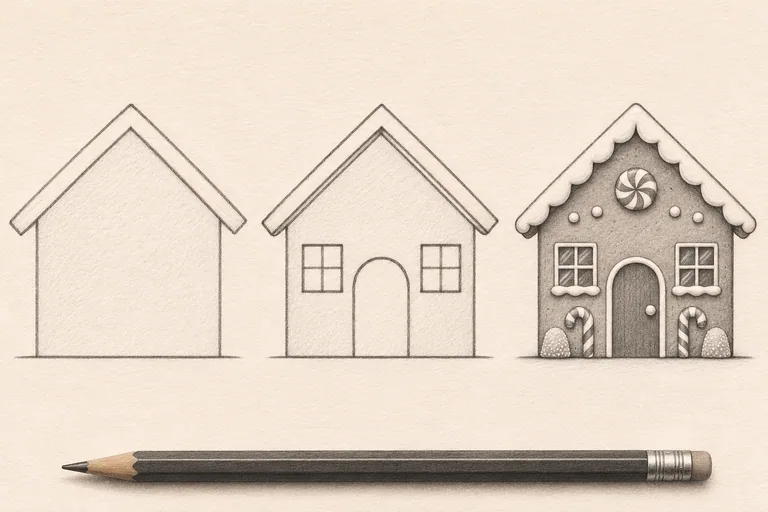
Lightly mark the total width and height. Draw the wall rectangle, then add the triangular gable above it. Find the roof peak relative to the center of the front wall. Compare the two roof slopes rather than assuming your reference is perfectly symmetrical. Leave room for a roof overhang on both sides.
Mark the ground contact and the widest reach of the roof. Check the house before adding any sweets: does the peak belong to the wall below, and does the roof extend far enough to cover that wall? An appealing outline is more useful here than a ruler-perfect line with impossible connections.
Give the roof edge a little thickness
Add a narrow second edge beneath the visible roof overhang, following its direction. This is a small structural band, not a second roof floating above the house. Stop it where another part hides it. Keep the front wall mostly plain while you place one door and two windows.
Compare the gap on each side of the door and the distance from the windows to the roof line. If your reference has uneven handmade details, keep a little of that character. Do not let a crooked window become an excuse for a door that extends below the ground.
Reserve icing as paper
Choose just three icing features: perhaps a roof-edge scallop, a door border and a few short roof marks. Draw their boundaries lightly, then shade the biscuit around them. Leaving those shapes unshaded lets the paper serve as the icing. A narrow shadow immediately below selected icing edges can suggest thickness.
Use a light middle tone across the biscuit and a deeper tone under the eaves. Keep the window and door recesses a little darker where the model supports that choice. Avoid an equally dark outline around every sweet; that can flatten the house into unrelated stickers.
Check the house before the last details
Hold the drawing away from you. The wall, roof, door and windows should read before you notice the dotted decorations. If the house looks busy, leave some biscuit areas plain rather than adding more marks. Add a short cast shadow at the base only if it agrees with your chosen light direction.
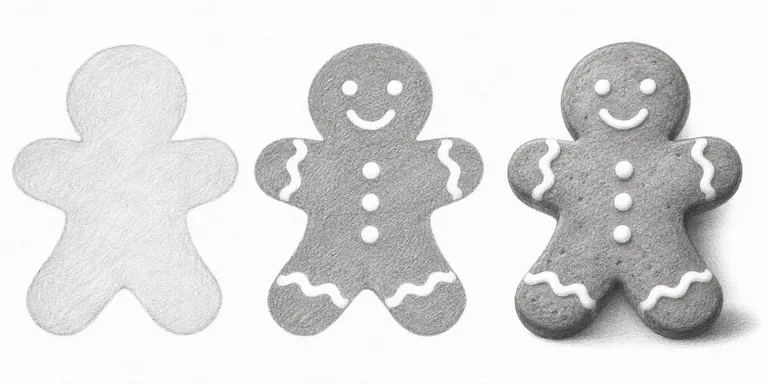
For a second drawing, keep the same house and change only the decoration. For an angled building, move on to a separate perspective study rather than bending this front-view roof at random. Compare the gingerbread-cookie lesson for another way to preserve white icing with pencil.