
Watercolor / Beginner
Mini Winter Watercolor Paintings: Three Small Scenes for Handmade Gifts
Paint three small winter scenes with a shared palette, leaving the snow white and giving each miniature one clear focal point.
Keep the painting small and the idea simpler
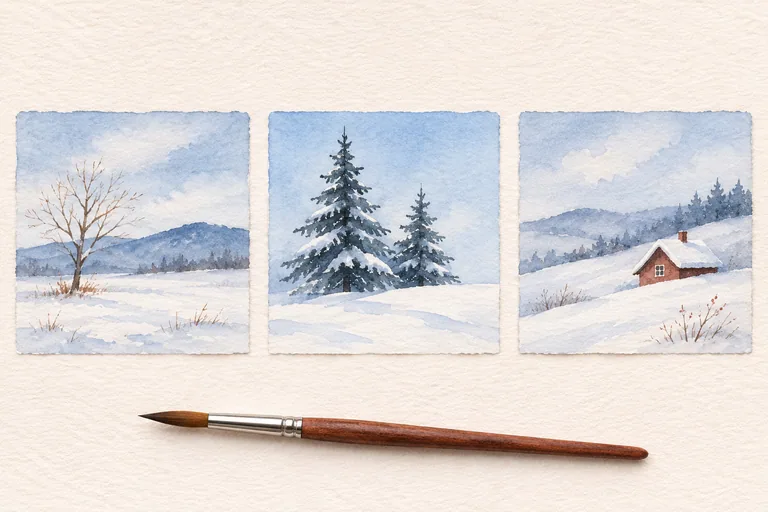
A miniature can become a gift enclosure, a small card front or a quiet sketchbook study. Small does not mean cramming a full landscape into a tiny rectangle. Give each scene one main subject: a bare tree, two pines or a cabin. Repeat a limited palette so the three pictures feel related.
Use watercolor paper, a pencil, a round brush with a useful point, clean water and scrap paper. Ultramarine and burnt sienna can make useful blue-gray mixtures; a separate muted red is optional for the cabin. Paint names and mixtures vary, so test your own colors. The sequence below is a proposed LUREXEN exercise, not a report of a physical paint test.
Plan three generous little squares
Lightly mark three squares about 7–8 cm across on one sheet, leaving room between them for cutting later. Keep a clear border inside each square if you plan to mount the paintings. Avoid pressing the pencil into the paper. Decide where the sky ends and where the untouched snow begins before reaching for paint.
On a scrap, try a pale sky wash and a darker tree mixture. Let both dry. If the dark barely differs from the sky, strengthen that mixture before painting the scene. You need readable contrast more than a large collection of colors.
Scene one: a ridge and one bare tree
Paint a pale blue sky above a gently uneven snow boundary. Keep the lower field dry and white. When the sky is completely dry, add a narrow distant ridge in diluted blue-gray. Make it lighter and simpler than the tree that will sit in front.
Draw the tree with your brush using a trunk that divides into fewer, thinner branches. Let the branches taper as you lift the brush. Add one pale blue-gray snow shadow near the base rather than outlining the entire white field. Stop before every open area becomes a branch.
Scene two: two pines and a quiet snowbank
Use a second pale sky. After it dries, place two pines of different heights on the snow boundary. Suggest the trees with irregular branching masses around a clear central direction. Preserve gaps instead of making two solid triangular cutouts.
Keep the nearer pine a little darker. A few cool marks beneath the trees can suggest a snowbank, but the largest lower shape should remain paper white. If both trees merge, let the paint dry and restore separation through a small adjacent darker accent; do not scrub a drying wash.
Scene three: a cabin that stays small
Sketch one box with a simple roof. Leave enough sky around it that the roof does not touch the picture edge. Paint the sky around the cabin shape and let it dry. Add a diluted muted-red wall wash and one darker opening. Leave the snow-covered roof white, with a pale cool edge shadow. Keep all roof edges connected to the walls.
Use one light shadow beneath the cabin to connect it to the snow. Avoid detailed bricks, smoke curls and many windows at this scale. If the building feels crooked, check the large roof and wall shapes before adding another dark mark.
Finish as a small gift
Let the sheet dry fully and flatten it gently under clean dry paper if needed. Cut with a ruler and suitable cutting tool, or use scissors for a softer handmade edge. Mount the painting on a card with an adhesive suitable for your paper. Write any greeting after the paint is dry. A finished painting is a paper artwork; it is not weatherproof decoration.
Compare all three from arm’s length. Each should have a clear light area and a small focal subject. For more practice, explore misty pine ridges through the lesson library if that subject interests you, or use the related winter workbook below.