
Watercolor / Beginner
Suggest a Lace Edge in Watercolor: Paint the Gaps, Keep the Paper
Turn a lace-inspired scallop into a manageable negative-painting exercise using six large openings instead of tiny decorative detail.
Simplify the pattern first
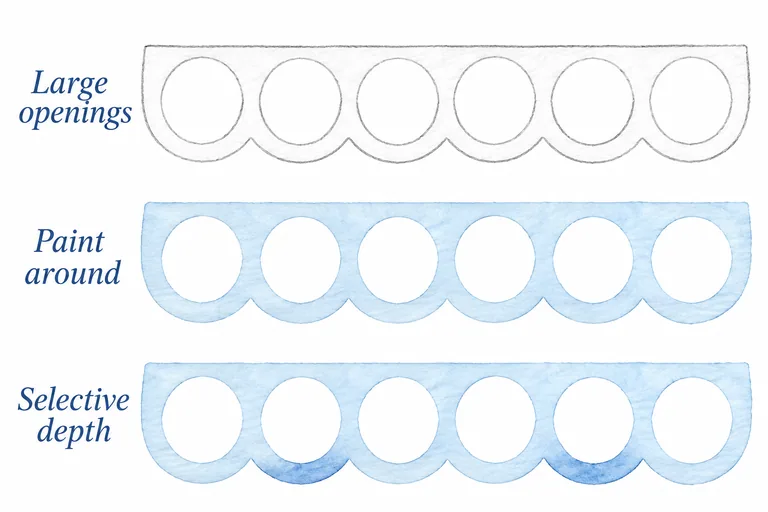
Draw a shallow curved edge with six broad scallops on watercolor paper. Inside it, place six large oval openings with generous gaps between them. This is a lace-inspired painting study, not a crochet or sewing pattern. You do not need to reproduce a real textile stitch by stitch.
Pinterest's 2026 report highlights lace and doily imagery. Our interpretation turns that visual interest into a negative-space exercise: the white paper describes the openings while a blue wash describes the surrounding shape.
Paint around one opening at a time
Test a pale blue wash and use a small pointed brush that still holds enough water for a continuous mark. On dry paper, paint the spaces between the reserved ovals. Join wet sections while they are still workable. If an edge has begun drying, let it finish rather than scrubbing it repeatedly.
Keep the openings comfortably large. Very tiny holes are harder to preserve and add little to the first study. The aim is a readable rhythm of light spaces, not an exact textile illustration.
Use a second layer selectively
Once the first wash is dry, add a slightly stronger blue beneath a few scallops. Leave the central area lighter. Do not outline every white opening in a dark ring: that can turn the delicate idea into a heavy pattern.
Check the rhythm
Step back and look at the spaces rather than the paint. Do the openings feel related without being mechanically identical? Is there enough blue between them for the shape to hold together? If several merge, try a second strip with fewer, larger openings.
Use the idea along one corner of a personal card or journal page after practising it separately. The generated example is illustrative; water, brush size, paper and pigment affect your result. Keep protected areas for handwriting blank and test any pen after the paint dries.