
Watercolor / Beginner
Watercolor Thanksgiving Place Cards: One Maple Leaf, Space for a Name
Paint a small autumn leaf on a folded place card, keeping the name area clear and testing the fold before making a whole table set.
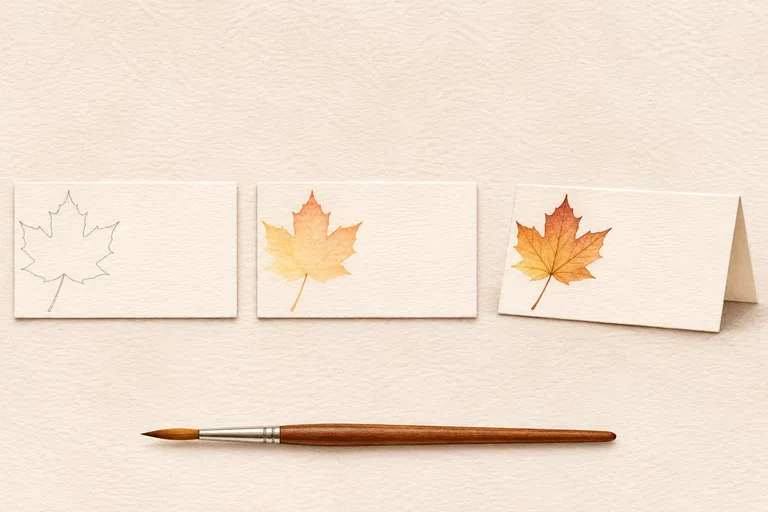
Start with one card, not a whole table set
U.S. Thanksgiving falls on November 26 in 2026. A small painted place card makes a useful preparation project: you can work ahead, leave the names until later and adapt the same leaf for another autumn gathering. This exercise uses one maple leaf on the left and a deliberately quiet name area on the right. It is an original LUREXEN practice plan, not a supplied printable template.
Use watercolor paper, a pencil, a ruler, a round brush, yellow or ochre and a red or burnt-sienna paint. Choose a pen you have tested on the dry paper for the names. Cut a trial rectangle about 12 × 8 cm; a fold across its middle makes a tent with a front face about 12 × 4 cm. These are suggested dimensions, not a printer setting.
Find the front face before painting
Fold the empty trial card first, stand it up and check that it is stable. Open it again and lightly identify which half faces your guest. Keep the fold out of the painted leaf. Allow roughly the left third of the front face for the design and the other two-thirds for a name. Try the longest guest name on scrap paper before deciding that the gap is large enough.
Use a real fallen leaf or your own photograph for the outline. Mark a short stem and five broad lobes. Make the spaces between the lobes clear without cutting a dozen tiny teeth into every edge. The silhouette should still read when you hold the small card at arm’s length.
Paint a pale base and one darker turn
Test a diluted yellow-orange mixture on a scrap of the same paper. Paint the leaf on dry paper, working carefully around its outline. While that leaf-shaped wash is evenly damp, touch a little warmer red into one or two lobes. Let the variation happen inside the shape; keep it away from the blank name area.
Leave the leaf to dry completely. Then add a short central vein and a few side veins with a slightly stronger mixture. Stop before the veins become a dark cage. If your wash has an interesting uneven edge, you do not need to outline the whole leaf to make it look finished.
Check the fold and the writing
Let the card dry flat before refolding it. Test the writing pen separately, then add a name only when the painted area is dry. If wet paint has weakened the fold or made the card lean, use the trial to adjust the paper and paint load before making more. A slightly larger card can be more useful than smaller lettering.
For a family table, let each person choose one leaf color while keeping the card size and name space consistent. Set paint water away from food and clear the workspace before setting the table. For a different layout, compare the botanical dinner-menu study; for other small seasonal pieces, see gift tags and place cards.