
Drawing / Beginner
Year-End Sketchbook Review: Turn Three Pages into One Practice Plan
Review three real drawings without scoring yourself, then choose one observable skill and a small repeatable exercise for the new year.
Choose three pages you can compare fairly
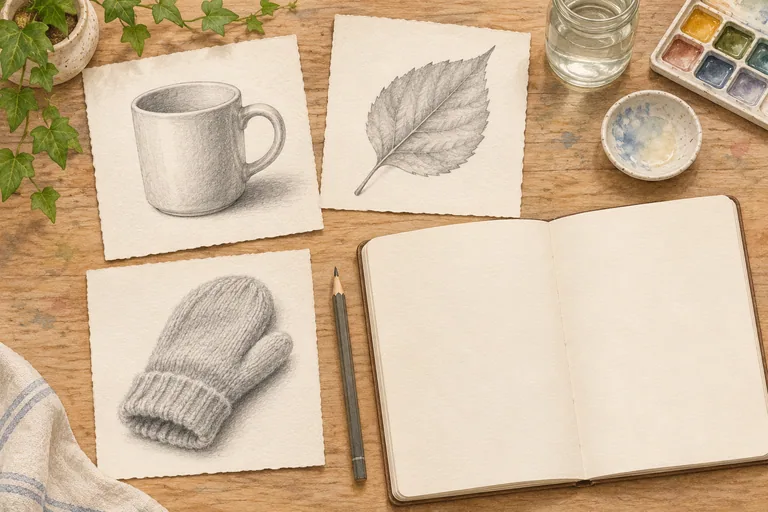
The end of the year can be a useful point to look through a sketchbook, but a review does not need a ranking or a dramatic before-and-after story. Pick three drawings you actually made. Choose pages with at least one comparable feature, such as an ellipse, an overlap, a light-and-shadow division or a curved outline.
If you have only a few drawings, use those rather than inventing a history of progress. If you have none, make one short observation drawing now and use it to plan the next practice session. The review is a decision tool, not a test of talent.
Describe what is visible, not what you are
For each page, write one factual observation. Useful examples include “the back rim meets both sides of the cup,” “the far leaf is hidden at the crossing,” or “the cast shadow points away from the light.” These describe a drawing. Labels such as “I am terrible at perspective” do not tell you which line to adjust next.
Keep one useful decision from each page as well as one unclear area. A broad shape that works is worth noticing even if the texture is unfinished. Avoid comparing a rushed five-minute sketch with a carefully polished hour-long drawing as though the conditions were identical.
Separate construction, value and finish
Look at the outline and connections first. Ask whether the main parts fit together and whether the proportions support the subject. Then look at the large light and dark groups. Finally, consider texture, tiny accents and decorative detail.
This order helps prevent an attractive surface from hiding a construction problem. A neatly shaded mug handle still needs a believable attachment. A detailed leaf still needs a coherent central direction. Choose the most useful early-stage correction before planning more finishing work.
Turn one observation into a small exercise
Write a single next-step question, such as “Can I draw three cup rims that connect to their side walls?” Choose one ordinary subject, one material and a short session length. Repeat that exercise a few times on separate dates if the schedule suits you. Keep the same main task so the comparison remains meaningful.
For example, use a plain mug, an HB pencil and ten minutes. Draw the large shape first, check the opening, then stop before adding pattern. On the next attempt, change only one thing you noticed. This is more specific than setting a goal to draw perfectly every day.
Leave room for the next page
Give the review one small area of a page and leave space beside or after it for the next attempt. Add your own dates if you find them useful. Do not copy dates or labels from the illustrative image, which contains no genuine learner results.
If you want ready-made prompts for short sessions, compare the December drawing countdown. For a value-focused next step, try the three-group still-life exercise. At the end of the review, you need one workable question and a place to begin, not a verdict on your entire year.