
Watercolor / Beginner
Paint a Christmas Cactus: Jointed Green Stems and One Pink Flower
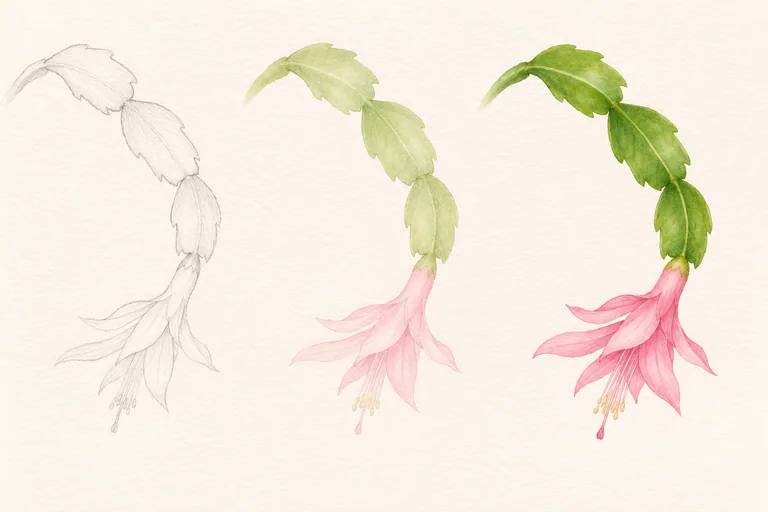
Study a small holiday-cactus branch by connecting flattened stem segments before painting one pendant flower at its tip.
Observe the plant you actually have
A holiday cactus offers a different festive painting subject from a poinsettia or an amaryllis. Plants sold around the season include different Schlumbergera forms and cultivars. Their flowering time and segment edges vary. This lesson is a small visual study, not an identification key or a plant-care prescription.
Choose a real branch or your own photograph with a clearly visible flower attachment. Look for one arching chain of flattened green stem segments and one flower near its tip. Those green pieces are stem segments, not a row of ordinary leaves attached to a separate woody twig. Keep that distinction in the drawing.
Map the joints before the outer contour
Use watercolor paper, a pencil, a round brush, a green mixture and a pink or red paint. Lightly mark the route from the supporting stem toward the flower. Place the joints along that route before drawing each flattened segment around them. Compare the segment lengths and the angle changes at the joints.
Allow a little overlap where the viewing angle hides a connection. Do not draw every segment as an identical bead or leave tiny unconnected gaps between them. Keep the outer scallops or points broad enough to paint at the scale you chose.
Keep the first green layer light
Test your green on a scrap of the same paper. Paint a pale base across one or two connected segments, preserving a small lighter strip where the reference catches light. Work on separated areas if neighboring wet shapes are merging more than you want.
Let the base dry. Add a few darker accents near the selected joints and along the shadow side. Avoid tracing a dark border around every segment. A slightly varied green can suggest the changes in surface without filling the whole branch with small texture marks.
Attach one flower before adding petals
Locate the flower’s attachment at the end of the branch and lightly map its overall tubular direction. Then place a few overlapping petal shapes around that structure. Check whether the flower faces sideways, down or partly toward you; the reference matters more than a memorized flower symbol.
Paint a pale pink first layer and allow it to dry before separating selected overlaps with stronger pink. Keep some petals quieter. Add only a few fine stamens if they remain readable at this size. Do not let a spray of decorative lines hide an attachment that never joined the stem.
Finish with a connection check
Follow the branch again from its first visible segment to the bloom. Every joint should connect, and the flower should belong to the terminal structure rather than float nearby. Stop once the arch and one bloom read clearly. A whole pot full of flowers is a separate composition problem.
For another holiday flower with a different structure, compare the amaryllis overlap study. The illustrated branch is simplified and AI-generated; use your own plant as the authority for its segment shape and flower arrangement.