Beginner / Technique studio
Blind Contour Drawing: Looking, Not Likeness
Try a short blind contour drawing of a mug, then compare it with a separate observed sketch. Practice following edges without judging it as a finished illustration.
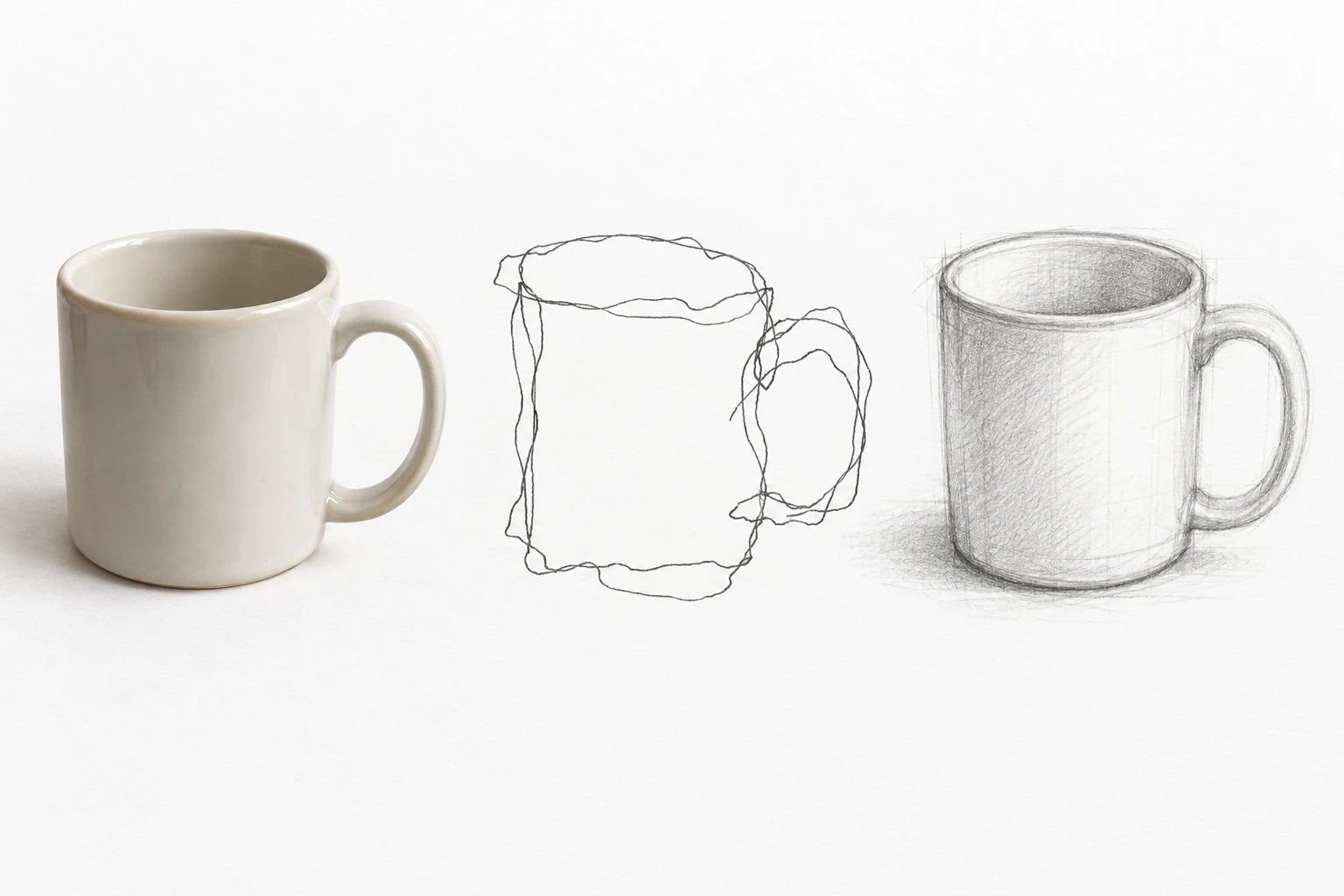
One focused technique study.
Keep the first attempt small enough to repeat. Your own subject, paper and materials are the reference.
- Level
- Beginner
- Practice time
- 15–20 minutes
- Skill focus
- Following observed edges and separating attention from likeness
- Success looks like
- Identify one edge or direction change you noticed, then use it in a separate observed drawing.
Materials
- Drawing paper, a pencil and eraser
- A stable mug or similarly simple household object
- A comfortable place to sit and an optional short timer
Identify one edge or direction change you noticed, then use it in a separate observed drawing.
Choose a stable subject and a limited goal
Place a mug where its outside edge and handle opening are visible. Keep it still and choose a comfortable viewing position. Blind contour means looking at the subject rather than monitoring the drawing; it does not mean closing your eyes, wearing a blindfold or working where you cannot see the setup safely.
The aim is not to prove that you can draw a realistic mug without looking. An awkward line can still record a useful observation. Start with a short route around part of the outline rather than planning a complete finished illustration. A simpler object is a practical choice, not an easier test you must pass.
Connect one visible edge with a starting point
Choose a visible point such as the left end of the rim. Put the pencil at a corresponding starting place on the page, then return your attention to the mug. Move the pencil as your gaze follows that selected edge. Keep the motion slow enough to notice changes in direction.
Avoid filling in the familiar symbol of a cup from memory. Look for the actual relationship between the rim, side and base in your view. You may stop after one short passage. There is no need to keep the pencil moving continuously if your attention has drifted away from the subject.
Follow the route without checking its appearance
Continue around the chosen passage while keeping your gaze on the object. If you reach the handle, notice where it meets the body and where the empty opening begins. Let the line on the page wander without looking down to repair it. This exercise is intentionally different from normal proportion checking.
Use a brief interval you can sustain comfortably; a short first attempt is enough. If a timer makes you rush, omit it. Pause when you lose the connection between looking and moving rather than speeding up to finish. Do not press harder because the line feels uncertain.
Review observations instead of scoring resemblance
Look at the drawing after stopping. Name one feature you noticed: a change at the lip, a narrow gap near the handle or a turn into the base. The question is what held your attention, not whether a stranger could identify the object from the sketch.
Leave this first drawing unchanged. Do not draw a more accurate outline over it to hide its route. A note beside the sheet can separate your observation from your judgment: “I noticed the handle gap” is more useful here than “I am bad at mugs.”
Make a separate sketch with normal visual checking
On another sheet, draw the same mug while looking between the subject and paper normally. Check width, height and handle placement using the view in front of you. Bring one observation from the first exercise into this drawing, such as a more deliberate rim-to-side transition.
The second drawing is not a repaired version of the blind contour. It uses a different working method and answers a different question. Compare the two without claiming that a single exercise caused a lasting skill change. A clearer edge decision in this particular attempt is enough to record.
Repeat a shorter route and keep the result honest
Try the same selected edge again with a shorter route or slower movement. Keep the subject and viewpoint stable so the comparison is meaningful. Look for a direction change you skipped earlier. If you want to practice the handle opening, make it a separate small exercise rather than forcing everything into one line.
Blind contour is one observation activity, not a replacement for construction, value work or regular looking at the page. This lesson makes no therapeutic, brain-hemisphere or guaranteed improvement claim. Return to normal drawing afterward and keep whichever observations help the subject you actually want to draw.
Change one decision, not everything.
Common mistakes
The result is judged only by likeness
Identify a noticed edge before evaluating realism.
A timer becomes a race
Shorten the route or omit the timer.
The first line is hidden under corrections
Keep it unchanged and compare a separate observed sketch.
Think it through
Try answering these questions in your own words, then open each answer to compare. Use the self-check below to review your actual study.
Should I close my eyes for blind contour drawing?
Place a mug where its outside edge and handle opening are visible. Keep it still and choose a comfortable viewing position. Blind contour means looking at the subject rather than monitoring the drawing; it does not mean closing your eyes, wearing a blindfold or working where you cannot see the setup safely.
Practice step: Choose a stable subject and a limited goal
How should I judge a drawing with unusual proportions?
Look at the drawing after stopping. Name one feature you noticed: a change at the lip, a narrow gap near the handle or a turn into the base. The question is what held your attention, not whether a stranger could identify the object from the sketch.
Practice step: Review observations instead of scoring resemblance
Review your own study
Tick what you can observe in your work. If a point is unclear, open its practice reminder. Choose one point to focus on next.
Tick a point only when you can observe it in your study.
Choose one focus for your next attempt using the circle beside a point.
This is your own reflection, not an assessment of your artwork. Choices are not saved or uploaded and reset when this page reloads.
Further learning and source context
Original LUREXEN exercise. Further reading supports the general methods, not a recorded test of the illustration.