
Drawing / Beginner
Draw Scissors by Their Gaps: Handle Loops, Blade Angle and One Pivot
Use the empty shapes inside and between a pair of scissors to check proportion before shading the metal.
Set a stable subject
A pair of scissors is a useful observation exercise because its empty spaces are easier to compare than its familiar name suggests. Place a simple pair flat on a table with the blades slightly open and pointing away from you. Keep them still while drawing. This is an adult still-life exercise; keep sharp tools out of children’s reach and use a photograph when handling them is unsuitable.
Use plain paper, an HB pencil and an eraser. Work from one fixed viewpoint so the handle loops and blade angle do not change between glances. Leave the brand lettering and tiny markings out of the first study.
Map three empty shapes
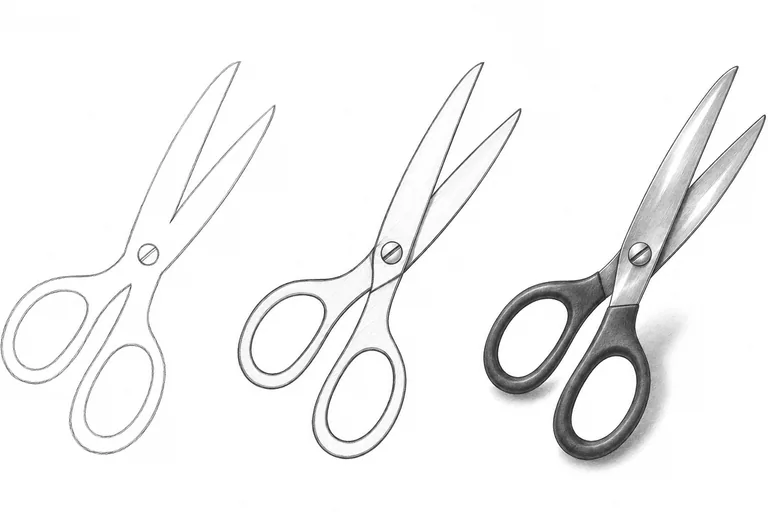
Look at the two openings inside the handles and the wedge between the blades. Sketch those gaps lightly before drawing the whole outer contour. Compare their height, width and tilt. The loops may be unequal, so do not automatically turn them into matching circles.
Mark the pivot’s position relative to the handle openings and the blade tips. Use it as a single anchor point. If the drawing begins to stretch, compare the distance from the pivot to each end rather than correcting every small edge separately.
Connect each handle to a blade
Add the outside edges around the gaps. Follow each physical arm through the pivot to its blade. Watch which part sits in front at the crossing. A common mistake is drawing the two halves as unrelated shapes, which leaves an impossible connection around the screw.
Before shading, check the width of each blade near the pivot and its taper toward the tip. Keep the tips modestly separated. If the central wedge looks wrong, adjust its edges while the drawing is still light.
Use long value shapes for metal
Choose a few broad light and dark bands visible on the steel. Preserve a narrow light strip where your reference reflects the light, then add a darker neighboring area. Avoid covering the blades with random short scratches. The metal can read through a small number of clear value changes.
Shade the inner walls of the handle openings enough to show thickness. Keep the pivot screw distinct, but do not make it the darkest mark simply because it is circular. Add a quiet cast shadow if it helps separate the object from the table.
Turn the paper and check the gaps again
Rotate your drawing upside down and compare the three empty shapes with your reference. This can make a stretched loop or an overly wide blade opening easier to notice. Make the correction in the outline before strengthening the darkest values.
Finish when the loops, pivot and two blades connect clearly. For a larger negative-space subject, try the chair-gap lesson. For another small metal object, compare overlapping keys. The generated illustration is simplified; your own scissors remain the reference for their mechanism.