Beginner / Technique studio
One-Color Watercolor Challenge: 7 Small Value Studies
Try a seven-study one-color watercolor challenge using dilution, reserved paper and dried layers. Practice value with original prompts and no special paint set.
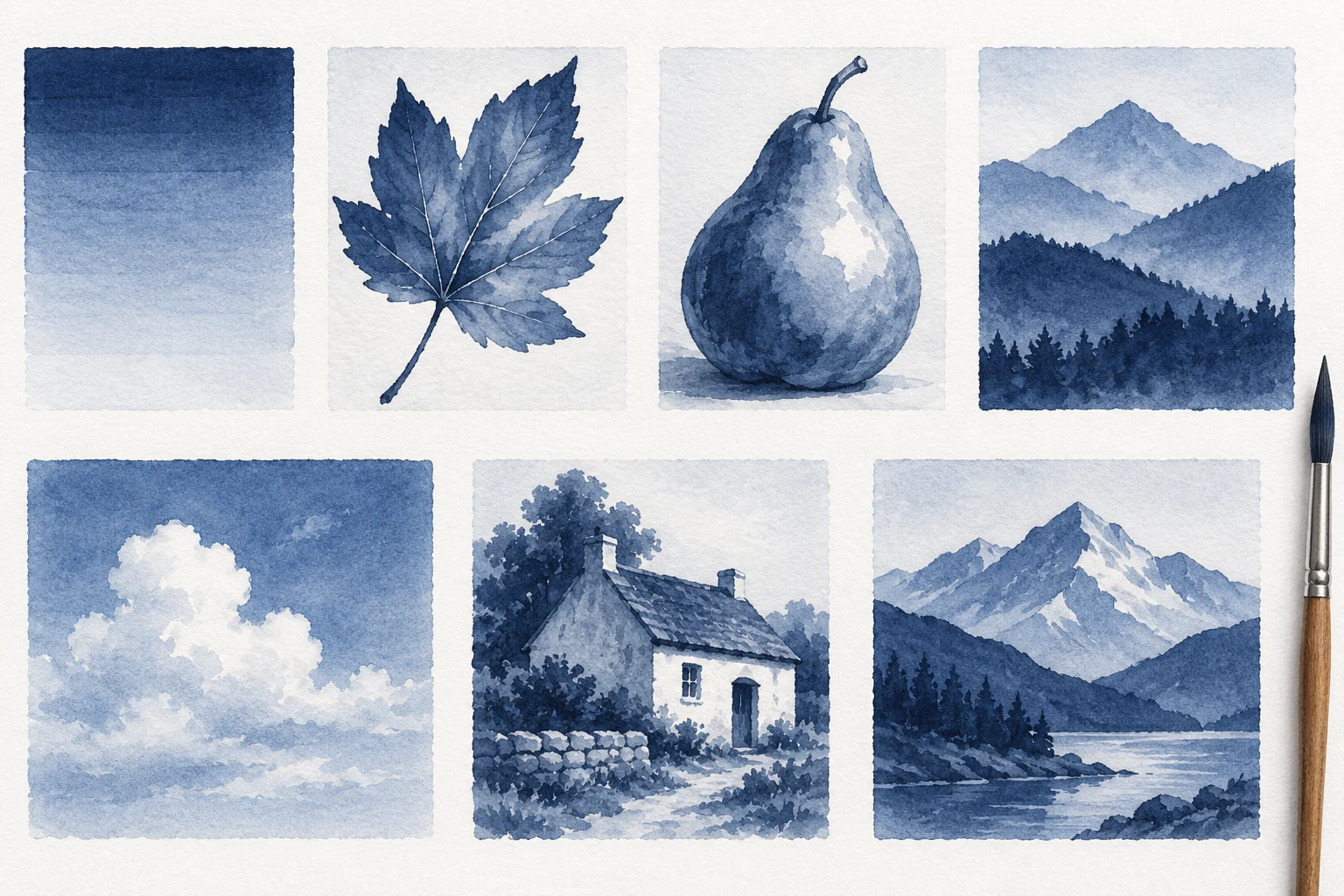
One focused technique study.
Keep the first attempt small enough to repeat. Your own subject, paper and materials are the reference.
- Level
- Beginner
- Practice time
- 15–25 minutes per study, plus drying
- Skill focus
- Value separation, dilution and deliberate repetition
- Success looks like
- Use one paint to distinguish light, middle and dark while keeping some paper unpainted.
Materials
- One familiar watercolor paint capable of a useful value range
- Watercolor paper divided into seven small study areas
- A round brush, clean water and palette
- Scrap paper and a pencil for reflection notes
Use one paint to distinguish light, middle and dark while keeping some paper unpainted.
Choose one paint and test its actual range
Pick one familiar paint and make a light, middle and dark swatch by changing dilution. Let the marks dry before comparing them. Some colors offer a narrower value range than others, so choose a paint that gives you useful separation without forcing a thick, opaque-looking layer. No special brand or new palette is required.
Set aside seven small areas, leaving clean gaps between them. You can work across several days or repeat the same study in separate sessions. This is an original LUREXEN prompt sequence, not an official Colortober list or a promise that daily painting must produce a polished result.
Studies one and two: separate wash from silhouette
For study one, make a small graded wash that moves from darker at one end to lighter at the other. Work with a prepared mixture and stop before repeatedly brushing a drying passage. Note where the change feels gradual and where a hard edge appears.
For study two, paint one simple leaf silhouette on dry paper, leaving the background white. Use your own leaf or a familiar shape. Keep the outline readable before adding a vein. Compare how the same paint behaves in an open wash and inside a controlled shape.
Studies three and four: describe form and overlap
For study three, draw a simple pear or rounded stone. Reserve a light patch and paint a pale first wash. Once dry, add a darker side passage to suggest the form turning away from your chosen light. Keep a small contact shadow separate from the broad body.
For study four, paint two or three mountain silhouettes. Use a pale far shape, allow it to dry and add a darker near shape. Avoid giving every ridge equal contrast. The challenge is a readable overlap, not geological detail or an exact atmospheric formula.
Studies five and six: leave light and add structure
For study five, paint a small sky around a reserved light cloud shape. Keep the cloud large enough that it does not disappear between dark marks. Compare this reserved area with any softer edges you make while the wash is still workable. Do not scrub a finished wash back to white.
For study six, paint a simple cottage using a wall, roof and ground relationship. Decide which shape is light, middle or dark before painting. Use the same single paint for all three. A transparent pass over a fully dry region can deepen it, but test on scrap and avoid brushing the layer repeatedly.
Study seven: repeat the least clear result
Choose the study that taught you the most about a problem, not the one that already looks nicest. Repeat it with one change: larger reserved paper, a clearer dark group or fewer small accents. Keep the size, paint and basic subject similar so the comparison is meaningful.
Place both versions beside the dry swatches. Can you see three useful values before noticing details? If the answer is no, simplify the next attempt. One-color work is not automatically easier; it removes hue choices so you can notice value decisions more clearly.
Build a practice habit without copying a prompt calendar
Record one sentence after each study: what stayed light, what became too dark or where the paper was overworked. You may pause between sessions, change the order or repeat a prompt. The exercise remains useful without a seven-day streak or a social-media deadline.
Case for Making runs Colortober, a color-led October challenge; that verified event helped inspire the timing of this article. Our subjects and sequence are independent, and we do not reproduce its color list, imply affiliation or require its paints. Continue with your own observations once the seven tests are complete.
Change one decision, not everything.
Common mistakes
Every shape dries the same gray
Compare dry swatches and reserve a separate dark group.
A dark patch becomes thick and overworked
Test a suitable value range and build restrained dried layers.
The challenge becomes a speed contest
Allow drying and repeat one useful decision instead of racing.
Think it through
Try answering these questions in your own words, then open each answer to compare. Use the self-check below to review your actual study.
What should stay fixed in the one-color study?
Write the name of the single paint beside the studies. Change dilution or layer placement while keeping that paint choice fixed.
Practice step: Keep the paint choice consistent
How can I make the repeated study useful?
Choose the study that taught you the most about a problem, not the one that already looks nicest. Repeat it with one change: larger reserved paper, a clearer dark group or fewer small accents. Keep the size, paint and basic subject similar so the comparison is meaningful.
Practice step: Study seven: repeat the least clear result
Review your own study
Tick what you can observe in your work. If a point is unclear, open its practice reminder. Choose one point to focus on next.
Tick a point only when you can observe it in your study.
Choose one focus for your next attempt using the circle beside a point.
This is your own reflection, not an assessment of your artwork. Choices are not saved or uploaded and reset when this page reloads.
Further learning and source context
This is an original LUREXEN exercise. These sources support general material and technique decisions or explain topic selection; they do not document the exact study pictured above. No publisher artwork was reused.